
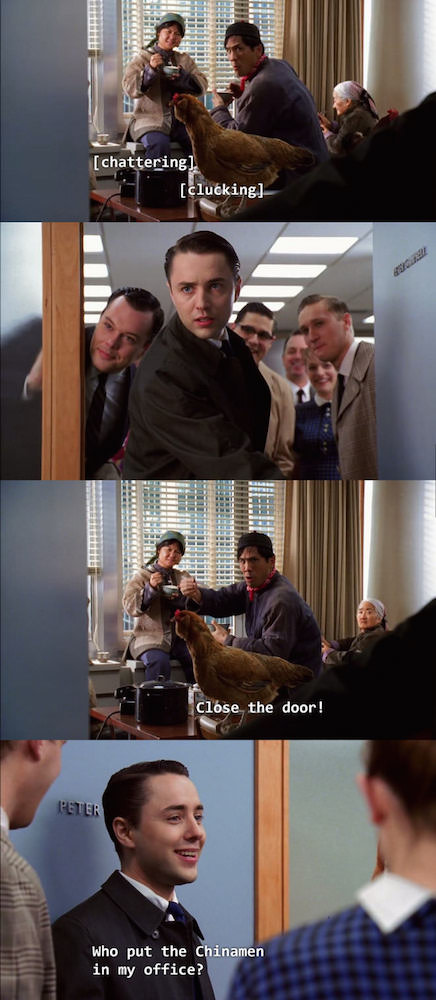
iconic s1. image courtesy of Tumblr.
“We knew we’d catch up with you eventually.”
That State Trooper nightmare holds some weighty foreshadowing. And, fun fact.. he’s the same actor who played that cop in s5e6 “Far Away Places”. Goddamn!
Jesus, that last episode of Mad Men was a sucker punch. I haven’t had a hell of a lot of time to organise my thoughts, but that penultimate episode hasn’t left my head; it resonated with me. We’ve watched Don shed more and more things as this half-season wears on; first his wife, then his furniture (involuntarily, but he seems happy about it), his apartment, his job, and now his car. I can’t help but be reminded time and time again of that bum from the iconic s1 episode “The Hobo Code”, because it feels like Don took so much of that guy’s viewpoint to heart it’s hard to ignore. It’s easily one of the most important episodes of the series.
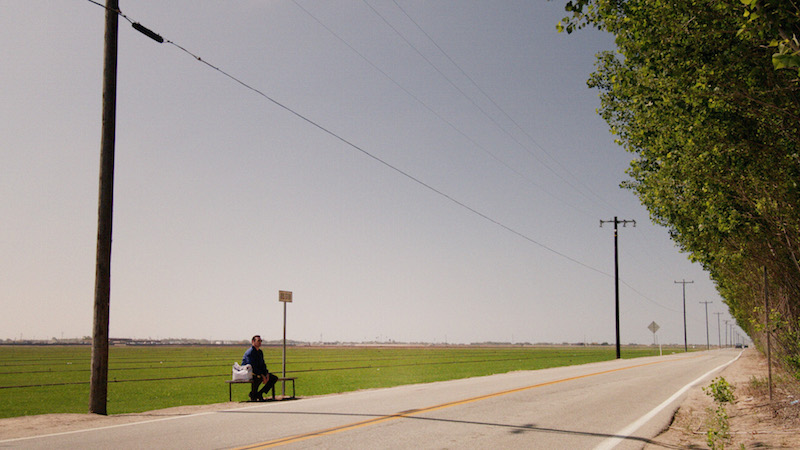
Even this past episode’s title, “The Milk and Honey Route”, is hobo code for a train/journey that rolls through a field of plenty – with a different meaning for every individual. A route that promises better things to come. Don’s route apparently involves a smackdown from an octogenarian WWII Vet with a phone book to the face, but when he gives away his Cadillac and sits on that bus bench in the middle of goddamn nowhere.. he looks the happiest we’ve seen him in a long time.
Another question that this series posits: what IS happiness, anyway? Besides the moment before you need more happiness, that is. It’s a look at the future — that future which Don was always envisioning in his pitches, that gleaming American Dream. What lies ahead, the promise of better things to come. The life that you can’t see just yet, but the one you daydream about.
Don has built a career hawking Things(TM) that are engineered to be tied with achieving that feeling of innate happiness, of contentment. It all goes back to the pilot.
“Advertising is based on one thing, happiness. And you know what happiness is? Happiness is the smell of a new car. It’s freedom from fear. It’s a billboard on the side of the road that screams reassurance that whatever you are doing.. is okay. You are okay.”
If I buy this thing, I’ll feel what I’ve been longing for; but nope, you just end up with a lot of shit at the end of it.

We’re on the road to nowhere.. image courtesy of ONTD
Even when he bought that Cadillac in s2e7 “The Gold Violin”, Don wavered because he didn’t know whether he deserved it or not. That status symbol rang hollow to him, a point driven home by little Sally asking “are we rich??” on their garbage picnic one Sunday with the Caddy. On the other hand, Roger’s words echoed through his head–“Like the song says: Enjoy yourself. It’s later than you think.” And I feel like he couldn’t get rid of that car fast enough at that bus stop.
Where will Don be in the finale? My guess (and the most obvious one at that) would be California. It’s always held such hope and opportunity for a fresh start to Don, but I think that hearing the news about Betty will boomerang him right back to New York. I mean.. it’d better. I feel like if he hears the news of Betty’s cancer and she dies while he’s outta the loop, that will be something that truly breaks him. I really hope that’s not the case.
This show has always had a couple of central thematic elements at its core; the grim spectre of death, and ‘can people really change?’ When two important women in Don’s life died from cancer, he wasn’t able to get out of his own way to help or be there in any capacity. Maybe he’ll get his shit together for Betty? My ideal Mad Men ending is taking it back to s1e13 “The Wheel” and in this version, Don actually makes it to Thanksgiving dinner. Yeah yeah, it’s Norman Rockwell as shit.. but then again, who the hell knows what’s going to happen?
I’ve seen a lot online about how people think Betty’s most recent storyline and fate is some form of either cheap, bad writing, or doing her dirty; personally I feel like this is the most compelling and appropriate end for her. Don’t get me wrong, I uglycried during this episode; it was difficult to watch, and I totally lost it when Henry broke down telling Sally the bad news. That’s also likely the first time Sally has seen a grown man exude that kind of emotion. But I was also blown away by Betty’s stoicism and acceptance, and knowing exactly when it’s over. Can people really change? Not entirely, per se, but they can get to know who they really are at their core and learn how to function and move forward within that paradigm. Look at Pete, who has finally accepted his own nature after a long struggle; he’s set to be the King of Wichita.
Remember the first Betty-centric plot in s1e2 “Ladies Room”? It deals with her crippling anxiety, due mostly to the death of her mother a few months prior. She’s so nervous and wound up that her hands go numb; she crashes their gigantic yellow car into someone’s birdbath, then has a miniature breakdown to Don wondering what would’ve happened had Sally ended up with a permanent scar on her face. Yikes. It’s clear that Betty was raised to be beautiful, by a woman who instilled the idea that good looks and a perfect figure are the only social currency she would ever need in life. And not so naturally for 1960, Betty questions it.
“My mother wanted me to be beautiful so I could find a man. There’s nothing wrong with that. But then what? Just sit and smoke and let it go ’til you’re in a box?”
Huh. Is that All There Is?
In “The Milk and Honey Route”, we learn that Betty had to watch her mother die while all of the beauty her mother was so proud of completely evaporated in her horrible decline. Her mother deeply instilled that aforementioned standard of beauty; a standard that maybe Betty has felt oppressed by, but one I think that she has been empowered by. Betty is elated when recounting that she was an Italian designer’s muse (and showing off those incredible clothes made just for her), she’s proud of her modeling career, and is always charmed when a man is into her.
As an aside: Don, to an extent, also uses his looks to get away with bullshit nobody else could. Mathis astutely calls it when he tells Don in s7e10 “The Forecast”, “You don’t have any character. You‘re just handsome!” Christ, Mathis. Don takes that harsh observation like a bullet, and chooses to impart that wisdom to Sally; don’t be like your mother and I. We gave you your looks, it’s up to you to be more than that. And so on.
While her grim prognosis was a jarring left turn, it also makes damn near-perfect poetic sense for her character arc. I’m in the midst of rewatching s1 right now, and it’s like a slap in the face; of course this is how it would have to be. Betty has made significant strides in knowing herself, and learning about the people around her in the world. Her act of surrendering right away and giving instructions to Sally is her own way of not repeating her mother’s mistakes. Her closing part of the letter where she lets Sally know that marching to the beat of her own drum is a good quality to have in life is entirely heartbreaking; it made me wonder what adventures Betty could have had, had she not been so constrained by the era in which she grew up. Sally has that same inherent agency; she was just born into a more appropriate generation. As a result, Sally and her mother have a very complicated relationship. Betty was just coming to understand more of Sally’s behaviour in recent episodes, and in turn reflecting on her own treatment of her daughter. Moving forward.
Throughout the series, Betty has struggled with how to assert her independence, and refusing cancer treatment is the ultimate declaration. She won’t let the opinions of anyone, not Henry nor Sally, sway her decision.. she’s making the best choice for her own damn self. As a woman who had such little control over her life, she should at least have control over how she dies if she’s able.
Betty also remembers when her father died, and how frantic the immediate aftermath was — and that when Gene confronted her with his postmortem plans neatly laid out a few weeks prior, she did not want to listen (not entirely unlike Sally literally covering her ears as Henry broke the news).. but she was thankful that he put it all together. With that foresight, Sally will not have to witness a drawn out battle in which Betty loses the looks that were so important to her, and in the end Betty will go out looking like herself. In the Blue Chiffon, with the hair she likes, and the lipstick that she keeps in her purse. Even though Betty is not exactly fiercely conquering new frontiers like Peggy, she is still going out in a way that is the most “her”, and I feel like this will help Sally way more than Betty’s mother’s death helped Betty in the long run.
People are railing against her shallowness as well, but like.. do you watch this fucking show? It’s what Betty has been taught to value most in life, in a time when women didn’t question much of anything and just followed ‘the rules’. And hey, it’s easy to prefer intellectualism over vanity. Thoughts and ideas can transcend generations and looks will only be preserved with photographs, and even those fade every few decades. But Betty is no stranger to intellectualism, either. She speaks Italian. And when Henry confronts her with the hopelessness of life, the inherent futility of keeping up appearances when we are all constantly dying.. she replies simply, “Why was I ever doing it?” Because for Betty, the image is a truth in itself; it’s everything. It makes her happy, and damn it, that’s enough.
A big part of Betty’s character arc and evolution has been learning when it’s time to stop and let go. If anything, what Weiner wants us to take away from Betty’s overall story and perhaps the show itself, is that it’s imperative to accept when something has come to an end (so meta). Betty’s terminal cancer pretty much annihilates any nonsensical fairytale ending where Don and Betty reconcile. As much as we’d all love to watch these characters to the point where they all die off, it’s a show about actualization, about a form of reality. Betty, in her choice to further her education, finally became her own person. And by the conclusion of the series finale on Sunday, all of the characters will have reached a point that puts them nearly at complete odds with who they were at the start of the show.
And Mad Men itself, will then complete its’ own journey in answering the very question that was posed at the beginning of the series: “Can people really change?”.
Betty: “I’ve learned to believe people when they tell you it’s over. They don’t want to say it, so it’s usually the truth.”
Sally: “I’ll be with you. I won’t let you give up.”
Betty: “I know that.. and I don’t want you to think I’m a quitter. I’ve fought for plenty in my life. I know when it’s over. It’s not a weakness. It’s been a gift to me. To know when to move on.”




 the MARS DEN