It’s Mother’s day! Don is not fully engrossed in breakfast-in-bed-for-Betty, and promptly falls over while reading the funny papers on the staircase. Somehow, he narrowly avoids death. This falling-backwards-down-the stairs-thing is my actual nightmare, by the way.
He then reminisces about Adam being born, as we glimpse Uncle Mac and the gawky kid Dick Whitman once was. His stepmother named Adam after ‘the first man’ which is just so clever.
Mother’s Day is sort of bittersweet for Betty, whose mother died semi-recently. When she tries to open up and express what she’s feeling, a totally normal thing to do within the confines of marriage, Don shuts it down with his fucked out views on grieving, alluding to it as “extended self-pity”. Jesus Rollerblading Christ, that’s dark. Please refer to Sophia Loren’s face, above.
Here is the start of delving into Betty’s obsession with appearance. Clearly her mother instilled these ideas in her head from the getgo, and as a result she’s very concerned and insecure about ageing. Don is dismissive for all the wrong reasons and looks bored, which is always encouraging (once again, please refer to the flawfree Sophia Loren). He tries to turn it all into a bang sesh, and Betty flips the script, attempting to reel him in with reminders that she’s only for him. Don looks taken aback and a little irritated.
This is the first episode where we see Joan and Roger together, in the hotel afterglow. Their relationship seems comprised of witty banter, though you can see that he does care about her. She’s flippant about their whole arrangement, being pragmatic and knowing that it won’t last. Unflappable as usual.
And hey, here’s the first appearance of Freddy Rumsen! Good god is this guy delightfully insulting/tonedeaf about women. Fun fact: when it looks like someone is drinking too much in 1960, that person is a certified lush.
Peggy is discovered for her creative prowess in the Belle Jolie brainstorming session, which really launches her character arc. Joan is clearly semi-bored by the brainstorming sesh, snark all the way. She’s really unlike anyone in that room and knows it; it’s the same idea with Peggy, though different in the execution. Peggy is thinking of ways to write for the product, whereas Joan is just enjoying being in charge. Peggy doesn’t want to be one of 100 colours in a box, and she’s starting to find her footing and her voice.
Joan is irritated that Peggy was recognised for her budding talent re:copy. Of course, Joan has been recognised in the office, but I’d guess not necessarily for anything like that. More behind closed doors, no shade intended. Their unconventional lady kinship will grow throughout the course of the series.
Working on an account, Don needs to know more about Israel and Jewish history than he can infer from Exodus and history books. Natch, he rings up Rachel. He is uncharacteristically super tryhard during his ‘working lunch’ with her– he’s nervous and not put together, being overly complimentary, and Rachel is having precisely none of it.
They speak about Israel, as Don is trying to find something real and unsentimental. He can definitely relate to exile, and that’s about it thus far. Rachel leaves him with a lot to chew on. She refers to Israel as “more of an idea than a place”. And, utopia/utopos; meaning the good place, and the place that cannot be. A perplexing and captivating idea, reality for all walks of life.
Later, she rings her sister Barbara to chat about Don and whatever potential may possibly exist. Wise beyond her 28 years, she methodically maps out bits and pieces of what could or could not be.
“Sometimes, things come. Good things, but there’s no future in them.”
Since he couldn’t get it in with Rachel, Don heads to the Village to see Midge. Watching him in the dim beatnik bar is pretty amazing. He seems a little more at home around those types somehow, he’s funnier and a touch more real. “I blow up bridges.” Midge’s friend refers to advertising as perpetuating the lie, and though Don follows up with a snarky response, he doesn’t entirely balk at the idea.
Don: “People want to be told what to do so badly that they’ll listen to anyone.”
Roy: “When you say people, I have a feeling you’re talking about .. thou.”
Preach it, proto-hippie.
The ending of this episode is pretty fantastic. You can’t help but feel the loneliness and isolation seeping from these characters.
There’s a lot to unpack in this episode, but first we go from the metaphorical Who is Don Draper to the .. wait .. hold the goddamn phone, Who literallyIS Don Draper?
Adam Whitman pops up in the city, and Don is not pleased. Apparently someone does read Advertising Age after all. He comes to Don with love and acceptance, just happy to see his half brother after all this time and is met with stone cold rejection.
Mad Men gives us this suave untouchable symbol, this Don Draper and his illusion of complete control. He weaves bullshit webs, and Peggy gets stuck in one when she accidentally overhears his phone conversation with mistress Midge. When Betty and the kids turn up at the office for portrait day, Peggy assumes that Don’s gone off to get it in (when he’s really at lunch with Adam), and momentarily panics. As an honest person, Peggy doesn’t really know how to handle it but to Don, it’s second nature and he’s back with an effortless excuse.
He’s got it all in check until Adam shows up; his entire demeanour becomes the Don we come to know in the rest of the series moving forward. It’s almost like that Don didn’t exist until 5G. And then when he admits to Adam that he missed him, we see some warmth and hope, a glimpse at who he was.
“Of course I did”. The way Don’s face changes says it all. However, he stiffens at the end of the lunch, and his “this never happened” mantra begins. I feel like he’s not sure he believes it when he says it at this point, but it becomes true to him in time.
At first glance, this is a man who’s so deeply ashamed of his past that he’s pretty much panicking and launching money at the problem. But looking deeper, he feels isolated and this helps shed light on his actions; yet he does it to himself. He’s a self-haunted guy.
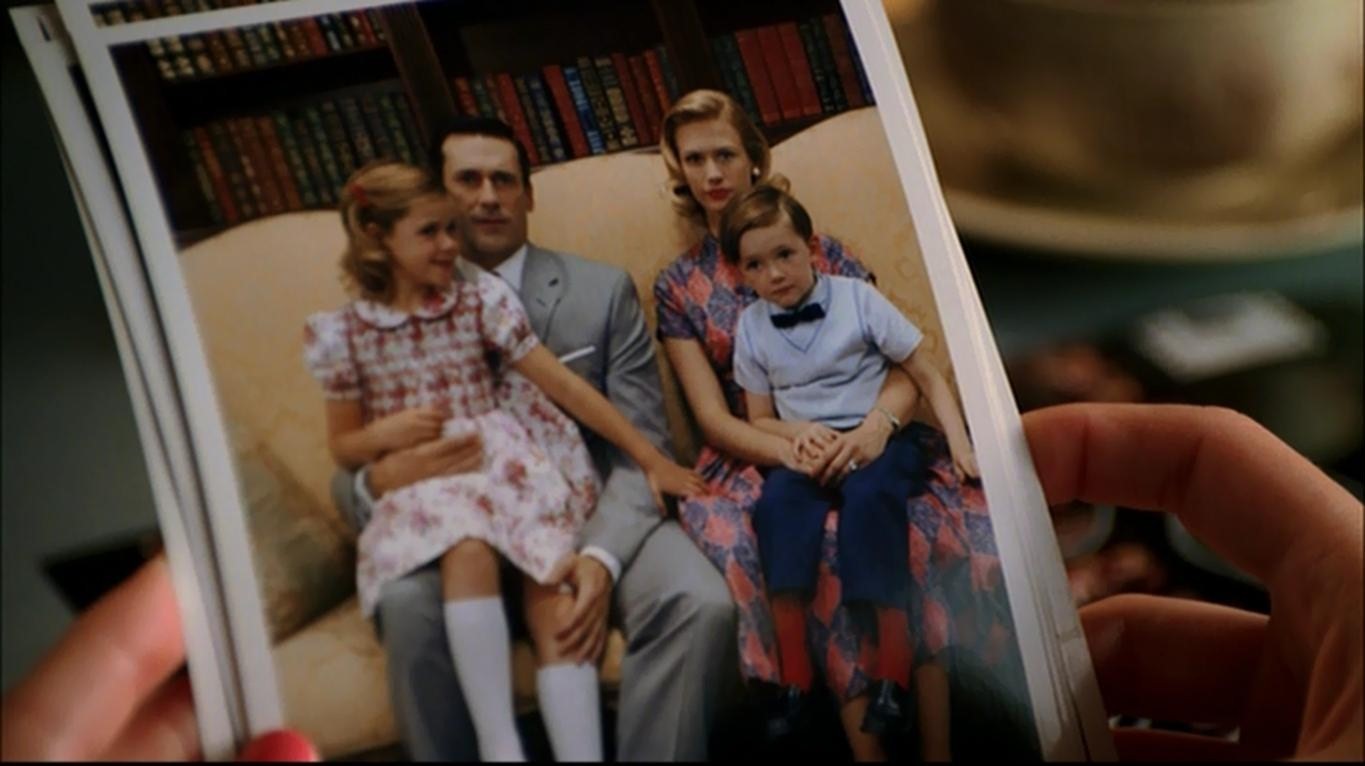
His entire façade crumbles then hardens– the tone of his voice resets, the whole nine. These are the roots of Don being a million miles away. He’s looking at an old photo of himself with Adam, whiskey in hand, burning it in an effigy to his past. He’s really driving home the tryhard THIS NEVER HAPPENED approach and it’s all so fucking dramatic, but it works in this context.
Brass tacks, all Adam wants is a connection with Don. Love, family, and companionship. Don isn’t prepared to offer any of these things, and only withdraws further over the course of the series/decade or so as the show goes on. It starts off as mysterious and interesting, but ends up being fucking depressing and infuriating.
“I have a life, it only goes in one direction — forward”.
Don’s fundamental misunderstanding of how human connection works is on display here. He’s plying Adam with 5 grand and quite literally cannot understand why he’s upset, cannot get why that isn’t enough. Don figures that he salted the earth of his past self and started over, why can’t Adam do the same?
One of the B plots in this episode is Kenny Cosgrove getting a short story published in The Atlantic, making the other Sterling Cooper guys jealous. Pete convinces Trudy to talk to her vaguely oily ex, and Pete is apoplectic that all she can “get” is Boys Life magazine.. haha. Roger jokes in a meeting that everyone at Sterling Cooper has the first ten pages of a novel locked in a drawer somewhere, Don quips that it’s actually five.. but all we see in his locked drawer is a bunch of Go Cash and things he’d rather forget. It’s all about projecting that image in whatever small way possible.
Seeing the stark contrast between Adam’s hellscape hotel room and Don’s lush master bedroom at home is pretty jarring. This thing Don has built for himself, he doesn’t want to lose that. He’s leaving behind that dismal past he doesn’t want in lieu of the persona he wants to attain, to play out.
“The only thing keeping you from being happy is the belief that you are alone.”
That’s some s2 Anna Draper realness right there, via tarot card. I can’t believe this show is over. After letting the finale wash over me for a bit, I think it was the most perfect conclusion to the story of Mad Men as a whole. Don’s journey is complete, and the other characters we know and love had fitting endings as well as new beginnings. We are left with a little ambiguity across the board, encouraged to think about their future and what will transpire. That’s the kind of series finale that really resonates with me. Some form of character-appropriate closure, as well as leaving things generally open ended. This way, the story never truly ends.
Throughout Mad Men’s run, I often wondered what Don’s true rock bottom moment would really look like. There’s been a vast array of messes on this show — the real Don Draper being blown up due to Dick Whitman being a klutz, Adam hanging himself due to Don pushing him (and thus his past) away, Betty finding out who he really is, Lane hanging himself, Sally catching him bonking Sylvia, the Hershey pitch/breakdown, getting put on indefinite leave, Meet The Mets, a random array of people hurling harsh dirty truth bombs in his direction.. so many dark moments.
And then, he encounters a sad man in a blue sweater at this retreat who rattles Don to his emotional core, who gets him at a very vulnerable moment. To me, Leonoard’s monologue almost sounds like the sequel to Don’s Hershey Pitch; the first part was about his sad lonely childhood, and the second part is about his sad lonely adult life. At least Leonard is choosing to share this intimate story with the correct crowd in the right context.. instead of in a boardroom with executives and your business partners.
“I’ve never been interesting to anybody. I work in an office, people walk right by me and I know they don’t see me.
Then I go home and I watch my wife and my kids – they don’t look up when I sit down.. it’s like no one cares that I’m gone.
They should love me, maybe they do, but, I don’t even know what it is.
You spend your whole life thinking you’re not getting it: people aren’t giving it to you.
Then you realize they’re trying, and you don’t even know what it is.
I had a dream I was on a shelf in the refrigerator. Someone closes the door and the light goes off, and I know everybody’s out there eating.
And then they open the door, and you see them smiling. They’re happy to see you.
But maybe they don’t look right at you, and maybe they don’t pick you.
Then the door closes again. The light goes off.”
Fucking hell. If that’s not the most devastatingly dead-on thing I’ve ever heard describing that feeling of being overlooked, that inherent emptiness..
Let’s backtrack for a hot minute. When Don is at the Hippie Compound comprised of People With A Lot of Feelings up in Big Sur, that was the place I least expected Don to be in life, and much less see him experience a true emotional breakdown/through. He’s come close to some form of truth before, but nothing has quite worked for him; the shame he feels is deep-rooted and extremely difficult to unpack. He’s so bogged down by his own headspace he hasn’t the faintest idea how to connect with anyone on a real, human level.
This guy is pretty into his own headspace. image courtesy of Deadspin
While off the grid, Don makes a series of devastating phone calls to the three women in his life; Sally, Betty, and Peggy. They all have heartbreaking conversations, each one unique to their relationship dynamics. Both Betty and Sally reject his urgency to come home, insisting it’s more normal without him there. Sad, but true.
Peggy sounds closest to that loving mother figure Don yearns for, expressing that she misses him and implores him to “come home”.. she exudes that unconditional love and understanding, but it’s almost like he’s tone-deaf to her concern. Don admits to her that he’s afraid, ashamed of the things he’s fucked up in his life, that he “took another man’s name and made nothing of it.” Peggy tries to reassure him that that’s not true. And hey, she would know on that last point; she’s still using skills Don has taught her from her early days at all incarnations of Sterling Cooper.
Don carries the burden of his past and his actions on his shoulders, and it’s all too much to bear in this moment. After hanging up, he collapses on the ground, unable to move. It hits him all at once, he’s despondent and broken. There was a split second of dread where I thought he was going to off himself, but thankfully that wasn’t the case.
What is his purpose? What does he do now? Where does he go from here? The identity crisis of Don Draper, at his breaking point. He’s the tragic hero of this story who runs away from himself, instead of looking inward to ask “but why am I running?” And now, finally, he’s getting around to introspection.
So much of the way you learn to love and be loved is due to your parents’ example as well as your upbringing, and we all know young Dick Whitman received fuckall in that department. As a result, Don never felt worthy of the attention given to him, he never seemed to understand what love was being given to him in any form. He had no idea how to connect with his children, as expressed in that sad conversation with Megan in s6e5 “The Flood”. He was wracked with guilt over being successful, and (quite incorrectly) thought that his success was undeserved because he took another man’s name; that original sin still haunts.
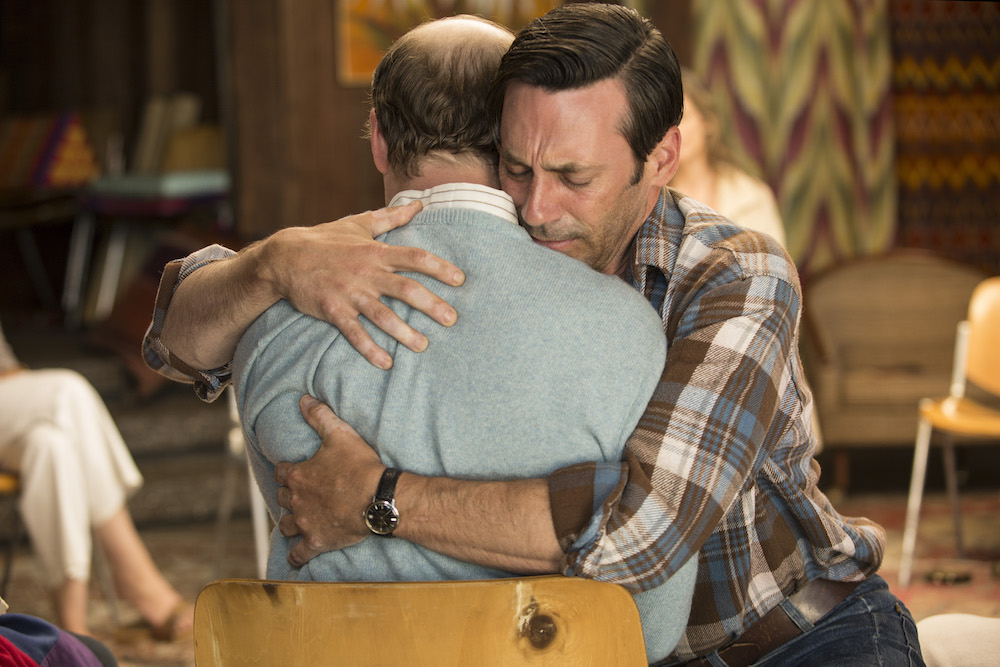
This stranger’s soliloquy speaks to that forgotten, afraid boy in the whorehouse. That dizzying, existential sadness Don feels is validated in that moment, and he finally grasps that he’s not alone. Don stares into the abyss, the abyss stares right back at him. A man who previously treated any outward signs of emotion as a weakness is seen here embracing a stranger and weeping right along with him. It’s a powerful moment. Honest to God I ugly-cried right along with them.
And in the end, it wasn’t over the top dramatic.. it was Don’s own rocky inward journey finally coming to a place of acceptance. He is Don Draper, the ad man. Seeing himself with clear eyes for the first time, knowing that He Is Okay: he can begin to heal. Hugging that man and crying with him is a genuine outpouring and catharsis of those negative feelings. He is hugging that man like it is the first time he has ever hugged or touched another person. After all, there’s a distinct difference between sharing physical space with a person and really seeing them and connecting with them.
Think back for a moment.
When we first see Don in the series premiere, he is the center of attention. Don is charismatic and people are drawn to him; he commands the room, seemingly effortlessly. Along the way there are several mentions of how he’s the face of their business. When he left this season, his absence reverberated.
But Don is so goddamn disengaged from his own life, so disconnected, that it’s gotten to the point where his dying ex-wife tells him it’s normal for him to be gone, to not really be an essential part of their children’s lives. Don comes to grips with this truth, and all he can squeak out is “Birdie….” and she knows that he understands, but is totally shattered. It’s pretty much the saddest goddamn phone call.
There are some people who are worried like Peggy, but the general consensus is that he leaves all the time.. it’s just a fact of life. “He does that.” He’ll be back at some point, even it has been longer than usual. Don himself is aware that he feels like a stranger in his own life, telling Anna in s2e12 “The Mountain King” that he feels like he’s on the outside looking in, that he’s ruined everything with his indiscretions and inability to connect. “I keep scratching at it, trying to get into it. I can’t.” Forever alone, adrift in a crowd. He hasn’t a single fucking idea what to do about it.
Remember that bizarre “walk around the room” exercise where Don is faced with an older woman and they have to express how they feel about that stranger without words? The dude has no fucking idea what to do. He’s got his arms crossed, the universal sign of being closed off, and is scanning the room for any sort of indication of how he’s supposed to act. The old lady doesn’t dig his vibe and shoves him. Don is jarred by this very clear message.
What gets through to Don, I believe, is that he unquestionably had what Leonard is desperately seeking, but shunned it and pushed people away because he couldn’t recognize it. People loved him and missed him when he left, but he couldn’t identify it; he couldn’t make any sense of it whatsoever in the least. Like he’s in a city where he doesn’t speak the language. People are trying their damnedest to love him, but Don has no earthly idea what in the world that even means. He alienated himself as a result, made himself closed off from his own life. Coming to the realisation that he did this to himself is not easy.
Don aligns with Leonard’s feelings, which he’s tried so hard to suppress his whole life, with his mantra of “this never happened”, “move forward”, etc. In the flashbacks to his childhood, you can see no one paid much attention to Dick just like Leonard. He was only noticed if he was being scolded for something, and his stepmother made sure to remind him that he wasn’t her son.
“I dreamt of it– of being wanted. Because the woman who was forced to raise me would look at me every day like she hoped I would disappear.”
from the Hershey Pitch– s6e13, “In Care Of”.
His innate desire to be wanted drove him to become successful, but also led to his immolation. Maybe he’d feel that love and acceptance others feel if he’s praised? However, it also led to his numerous affairs with God knows how many women/hookers where the ego stroking and personal affirmation were fleeting. The Man Hug allowed Don to see that he was not the only one with these feelings. He can learn to accept his past and forgive himself. This is the only way to truly change, to finally move forward in a healthy way. You can’t just ignore the past; it’s shaped who you are today, and it’ll be a fucking disaster if you suppress it. Accept it, love your damn self. Learn to live with who you are and work within that paradigm. It’s all a massive weight off his shoulders.
Mad Men has always spoken to me. The show touches upon feelings we have all felt at one time or another, the shared experience of “do people want me” in the simplest form, the despair of the day to day. The question, “is that all there is?”, looming. Can people really change? The short answer is YES, with an if.
I am a deeply flawed person — and seeing these other flawed characters forge their own paths and find happiness as it pertains to them has brought a lot of comfort. Joan started the series extolling the virtues of marrying rich, and has transformed into a savvy businesswoman. She chooses her career over a life of ease (and free blow) with leathery manbaby Richard; over the course of the series, she comes to the gradual realisation that her work brings her more satisfaction and sense of accomplishment than any man ever could.
In her marriage to Dr. Terrible Person, also a manbaby, she was seen as an intelligent and dominant woman who married someone because she felt it was the thing to do to fit in with the crowd. She has an uplifting ending to her story though: Joan chooses herself as a partner, literally and figuratively. The name of her new production company is Holloway-Harris, after all. You Only Live Twice, indeed.
This contrasts a touch with Peggy, who has thrown herself ambitiously into her work since day one, and defined herself by her job so much that she misses the forest for the trees; Stan right there in front of her face. She pieces it together that she’s in love with Stan in the most Peggy way possible; saying everything aloud and coming to the conclusion very analytically. Peggy will learn balance. She’s said throughout the series that she knows what she’s “supposed” to want, but that archetype of being a housewife never appealed to her, she’s always wanted more. And she learns to accept that and embrace it as the episodes go on. Peggy fucking rules. I bet she invents “Where’s the Beef??”
Roger’s story started off with him married 20-some years to Mona, with an ungrateful daughter who ends up joining that filthy hippie cult in upstate NY and is like.. gone forever. He didn’t do much but schmooze with clients, hit on twins, and have heart attacks initially.. but when Bert Cooper died he really stepped up. He’s been all over the place – divorced Mona, married and divorced from 20something year-old Jane, knocking Joan up in their post-mugging alley bangfest, on LSD impersonating our Lord Jesus Christ, and here he is presenting Joan (well, their son Kevin) with an inheritance so he’ll always be secure. She worries that Roger is sick, but he’s just letting her know he’s reached the twilight years of his life; he’s marrying Marie, a bomb that Joan delights in once Roger drops it. What a mess indeed. But hey, looks like Roger found his match for dry one-liners and drinking. I’ve always loved their dynamic, so that finish to Roger’s story works really well.
Plus, he gave Cooper’s tentacle porn painting to Peggy in s7e12 “Lost Horizon”. I really love this exchange between them, and I have a feeling it’ll only add fuel to Peggy’s “I don’t answer to anyone” fire (especially watching her bulldoze that dumpy middle manager at the most recent meeting).
Peggy: “You know I need to make men feel at ease!”
Roger: “Who told you that??”
And of course, it gave us this gem. So much bittersweet/surreal shit. Pardon the shit quality, looks like some guy recorded this from his TV.
Pete ends up right where he started in the best way possible, after being immature and boorish for so long in regards to.. well, pretty much everything and everyone in his life. At the start of things he envies Don, but then discovers bit by bit that it’s all a goddamned mess as he pulls back the curtain. Pete will never be the suave guy who charms a room, so he adapts to his surroundings and learns how exactly to work his ass off to get to where he is. He tries to build something instead of curating a specific image to skate by. And in a 4am epiphany moment of pure honesty and emotion, he reconciles with Trudy. He has a family again, and they are whisked off to Wichita by private jet, landing the corporate bigwig job he’s always wanted. A fresh start. Pete’s goodbye to Peggy is as self-aware as it is perfect. There’s no hint of his previous sourness, just an understanding of who he really is.
Pete: “Someday people are going to brag that they worked with you.”
Peggy: “What am I supposed to say to that?”
Pete: “I don’t know. No one’s ever said it to me.”
And then he gives her a cactus. Perpetual boob Harry Crane makes off with the cookies the girls made for Pete, which he tossed Harry’s way in order to get him out of the room. Story checks out. What a miserable pile Harry Crane is.
The final scenes with Betty are wrenching, but she’s going out on her own terms. I don’t know if Gene and Bobby will for sure end up with her flop brother and wife.. but that would secure a future for Sally, which I’m sure is part of what Betty intended. That way she wouldn’t have to quit school ad likely skip college to come home and care for them while Henry is at work and whatnot; the foresight is there, and Sally will realise that in time. Betty has come a long way since the start of the series, and though her end is tragic, she’s finally coming to grips with her own agency and encouraging that same feeling in her daughter.
A man like Don finding some peace at last after his tumultuous journey spanning 92 episodes is the best possible conclusion to the series that I could imagine. The actual closing scene is a brilliant “a-HA!” moment, Don meditating, closed eyes with a grin slowly forming.. ding. Thankfully he’s not dressed in a garbage hippie getup — he’s in a white buttondown and chinos, cleanshaven, hair oiled, so he is still himself. He’s taking it all in, relishing the first day of the rest of his life.
The iconic Hilltop Coca-Cola ad comes onto our screens and with it the implication that Don went back home to New York, back to McCann-Erickson and created this paragon. We can hope he did see Betty one last time, that he was there for his kids in a meaningful way. He went across the country, he went as far west as he could go and found some solace at last. We can only hope he brings it all back with him.
The song starts. At the time, I was thinking.. what in the whole entire goddamn world? It took a second to sink in, and then.. I LOVE THIS. It’s equal parts hilarious and ironic. Taking the Free Love, the hippies and peace and counterculture ideals of the 1960s and packaging it to sell fucking Coca-Cola? Hysterical. Sure, he’s selling out the counterculture in an ad for a massive corporation, but the counterculture that Don finds in California is almost exactly as flawed, manipulative, and irresponsible as the strict “Christian values” instilled by his stepmother which contributed to his lifelong mental turmoil. All that shame he feels, all of the weirdo Don Draper headspace; nonsensical guilt trips and constantly being overlooked will assuredly do awful things to your psyche.
So, whatevs. Cue some Deadhead ranting about “like, THE CORPORATIONS, man…..”
But hey, this is exactly what Don does best — dialed up to 11. It’s his enlightened Carousel. In real life, this fucking thing is the Mona Lisa of advertising. This ad has been reused and revamped as recently as 2010. I have a feeling that maybe Weiner could have used this as the jumping off point for the series; Hilltop is the pinnacle of modern advertising, the highest of the highs. Working backwards, what sort of headspace do you have to be in.. in order to come up with an ad like that? In the Mad Men world, that man has likely experienced a lot of pain in his life. He feels lost and wants to channel that into something to help people forget about that for even 60 seconds on their TVs. Who knows. (In real life, the ad’s creator was trapped at Shannon Airport in Ireland.. which is enough to make you lose your fucking mind as it is.) Interesting to think about, though.
I like that Don started the series hawking cigarettes, and now he’s ending the series hawking soda; the cigarettes of the 21st century. It’s full circle, but not in a derivative way. Don went round and round, and then back home again. To a place where he now knows he is loved.
People who are knocking it saying it’s cynical or dark or contrived have missed the point entirely. Take a step back and look. The ending is optimistic, and we are left with the hope that Don can move forward with his life and appreciate all that he has and truly learn how to love himself, love other people and to accept the love he’s given. After all, that’s what life’s about. And the happiness and contentment attained by the other characters in the finale isn’t just some arbitrary thing they are suddenly granted either; they have all been working toward their own sense of serenity.
But at his core, Don is and always was a gifted storyteller. He can be a changed man and still do the same job, still thrive in advertising, and still thrive creatively. He can accept his past and let go of his shame, he can accept his present as Don Draper, and he can move forward in a normal-ass way and operate within his own paradigm.
Why does Don love advertising so much? Because he’s trying to fill that emptiness within himself, that void he saw within Leonard. He knows other people across these United States feel it as well, and he knows how to tap into that need, that want, that craving for connection. But now, maybe he’ll be a little more down to earth about it.
I’m really sad that Mad Men is disappearing from the airwaves, but I have a feeling I won’t stop writing about it anytime soon. And I’m certain I’ll be re-watching the whole shebang for years to come. “Person to Person” is a meaningful capstone to an honestly perfect series, and the whole show has maintained a timeless feeling. I’ve enjoyed every single episode over the last 8 years (!!) and I am better for having absorbed all of it. I know to many people it’s just a show, but it’s certainly helped me through some tough spots and to see things a little differently.
Thanks for reading, kiddos, there’s more to come in the future. But for now.. check out the s7e1 opening scene, which takes on a touch of new meaning in light of how the show concludes. It’s a pretty impeccable bookend.




 the MARS DEN